Determine Workpiece-Specific Capacity Requirements
Measuring dimensional envelope, weight, and inertia for safe, stable machining
Getting accurate measurements of a workpiece's dimensions (length, width, height), its weight, and how it spins around its axis is really important for making sure machining stays safe and stable. When parts are too big for what the machine can handle, they start causing problems like bending, shaking, and messed up dimensions. This gets especially tricky when dealing with pieces over 15 meters long, which often need special gantry setups just to work properly. The spinning resistance needs calculation based on how mass is distributed across the part, something that matters a lot when running at high speeds. And let's not forget about clamping either. Too weak a grip on heavy stuff leads to disastrous slippage incidents all the time according to those 2024 safety studies we've been seeing lately. Machine shops lose tools and sometimes whole machines because of this oversight.
Avoiding over-specification: balancing rigidity, footprint, and total cost of ownership
Selecting excessive capacity introduces unnecessary capital and operational expense without performance benefit. Optimize specifications using three key criteria:
- Rigidity-to-Weight Ratio: Match column thickness to workpiece mass—for example, an 80-ton capacity typically requires ≥400 mm column diameter.
- Footprint Efficiency: Right-size X/Y/Z travel ranges to actual part dimensions plus 15% for tool clearance—avoiding wasted floor space and structural inefficiency.
- Total Cost Analysis: Oversized machines consume ≥25% more energy and incur up to 30% higher maintenance and operational costs, per the Manufacturing Efficiency Journal (2023).
Thermal growth in large components—often overlooked—can introduce micron-level inaccuracies; conversely, overbuilt machines deliver diminishing returns on precision while inflating lifetime ownership costs.
Select the Optimal Gantry Configuration for Rigidity and Scalability
Fixed beam vs. moving beam gantry: trade-offs in structural stability, travel range, and thermal performance
When comparing fixed beam versus moving beam gantry systems, engineers face different challenges depending on their needs. With fixed beam setups, the crossrail stays put while the worktable moves back and forth. This design offers rock solid stability, very little vibration, and great rigidity which makes them ideal for precision cutting tasks where accuracy matters most. But there's a catch: these machines struggle with really large parts because the movement range is limited. On the other hand, moving beam systems let the crossrail slide along the Y-axis, giving manufacturers access to much larger machining areas. However, this comes with drawbacks including heavier moving components, more vibrations during operation, and problems with thermal expansion as the drive systems generate heat over time. After running continuously for hours, temperature changes in moving beam machines can cause dimensional shifts measuring around 15 to 20 microns per meter, which affects how consistently the machine repeats positions across multiple jobs.
| Configuration | Structural Stability | Max. Travel Range | Thermal Performance |
|---|---|---|---|
| Fixed Beam | Excellent | Limited | Stable (Δ≤5°C) |
| Moving Beam | Moderate | Extended | Variable (Δ≤15°C) |
CNC double column machining center as a high-rigidity alternative for ultra-heavy, precision large-part work
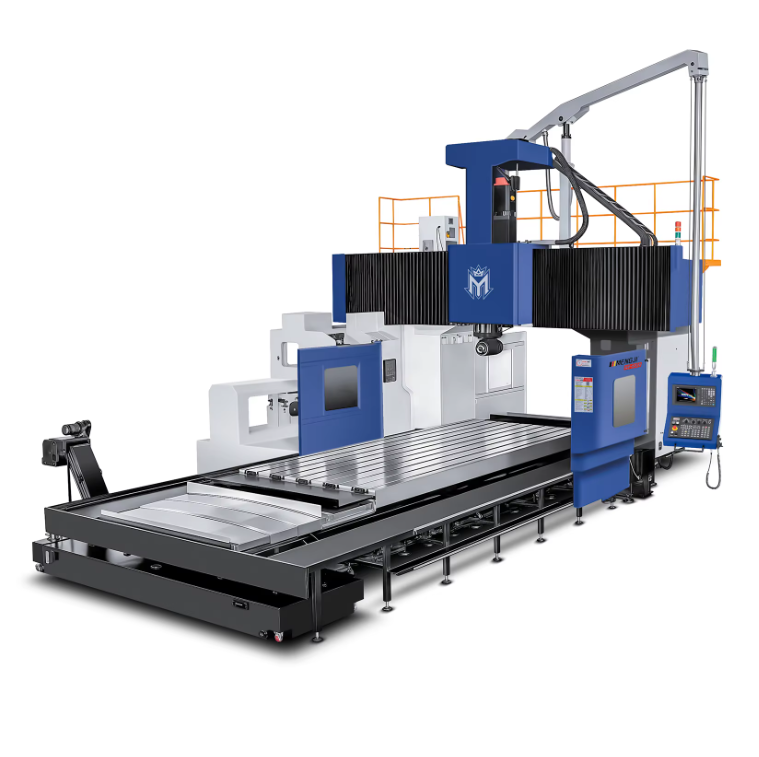
When dealing with really heavy parts over 30 tons like airplane frames or components used in power generation equipment, the bridge type CNC double column machining center stands out for its solid build. The machine has two sturdy columns that hold up a moving crossbeam which spreads out the cutting force evenly on both sides. This setup cuts down on bending by about half compared to machines with just one column, and it dampens vibrations three times better than those old style gantry systems. Plus, the whole thing is built inside an enclosure that keeps heat from messing with measurements. Even when working aggressively on tough materials such as titanium or hardened steel, these machines maintain tight tolerances around 0.01 millimeters across workpieces that can be as long as ten meters.
Match Axis Architecture and CNC Control Capabilities to Part Complexity
3-Axis vs. 5-Axis Gantry Mills: Evaluating Setup Efficiency, Part Handling, and Feature Accessibility for Large Workpieces
When deciding between 3-axis and 5-axis gantry mills, geometry matters more than part size. Most shops stick with 3-axis machines for basic boxy parts that have flat surfaces since these systems are cheaper to run and easier to operate day to day. But when dealing with complicated shapes like turbine blades, impellers, or those tricky aerospace brackets, there's really no alternative to going 5-axis. The big advantage comes from being able to spin the workpiece around during cutting. This cuts down on all those alignment headaches that happen when operators have to manually move parts between setups. Setup times can drop anywhere from half to three quarters depending on the job, which makes a huge difference in production runs. What really sets 5-axis apart though is how it handles those pesky shadow zones that plague traditional 3-axis machining. No more blind spots means tools can reach into undercuts, tackle compound angles, and get deep into cavities without missing a beat.
Advanced CNC Machine Tools Features: Real-Time Multi-Axis Synchronization, TCP Control, and Volumetric Collision Avoidance
The latest CNC controls come packed with features that really boost accuracy when working on big parts. When machines synchronize multiple axes in real time, they can coordinate rotary and linear movements together during complex operations. This matters a lot when dealing with tricky materials such as titanium which react badly to heat changes. The TCP control system keeps adjusting how the cutting tool faces the material surface as it works across complicated shapes. This helps maintain proper contact angles and cutting pressure throughout the job. For safety, modern systems also include volumetric collision detection that simulates movement before actual cuts happen. This prevents expensive accidents where oversized tools might hit fixtures or other parts of the machine itself. The result? Parts made within very tight specifications, around plus or minus 0.025 millimeters, and shops get their production lines running much quicker after setup.