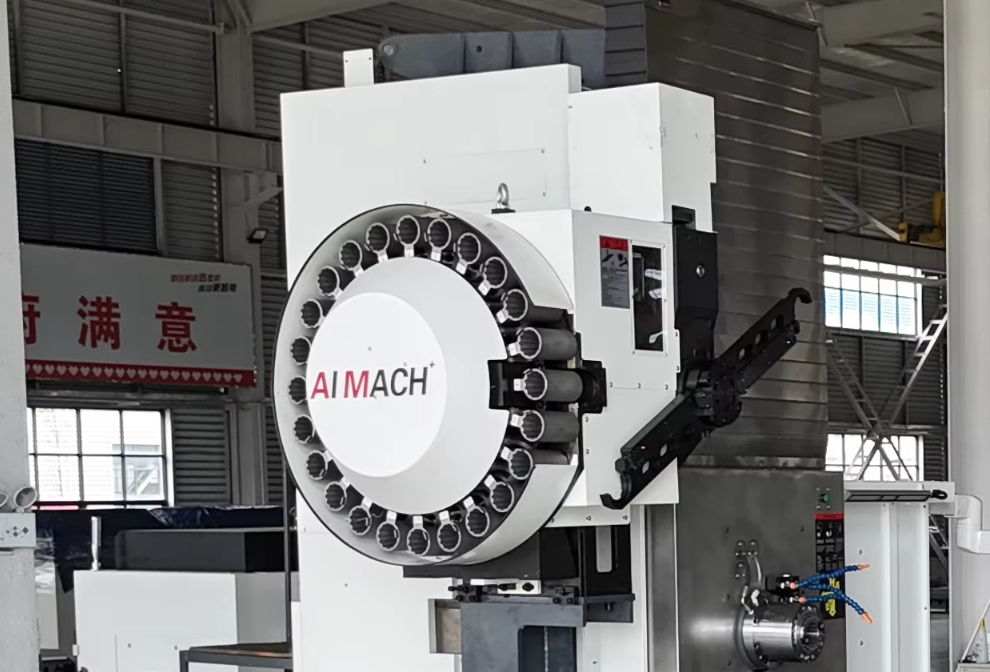
Structural Integrity: Rigidity, Load Capacity, and Gantry Frame Design
Payload, Stroke Length, and Stiffness Requirements for Large-Part Machining
When choosing gantry machining centers, manufacturers need to pay close attention to three main factors: how much weight the machine can handle, the reach of its movement range, and how solidly built it is. This becomes especially important when working on big items such as airplane structural parts or those massive wind turbine pieces. The weight capacity really matters for holding parts securely during machining operations. Machines that deal with parts over 10,000 pounds typically need extra strong cast iron bases with added ribs throughout to stop them from bending when heavy loads are applied. For components that stretch beyond 6 meters across both X and Y directions, having sufficient travel distance lets machinists complete entire jobs without moving the part around, which cuts down on setup times by about 30% for things like ship propellers. Structural rigidity measured in Newtons per micrometer isn't something that can be compromised either. Machines lacking enough stiffness will create unwanted vibrations during cutting, leading to surface imperfections, measurements off by more than 0.05 millimeters, and tools wearing out faster than expected. Frames made from mineral cast materials actually dampen vibrations better than traditional welded steel constructions by roughly 40%, giving shops a real edge when they're cutting tough materials like hardened steels.
Support Configuration Impact on Dynamic Stability and Thermal Error Compensation
The way gantry support systems are set up really affects how stable machines stay when running at high speeds. Most shops use either dual drive systems, hydrostatic guideways, or those fancy linear motor arrangements depending on what they need to do. When working with long spans, having two servo motors helps keep things straight and prevents those annoying torsion errors that mess up positioning. The result? Machines can maintain around plus or minus 5 microns accuracy even when accelerating at 1G forces typical in automotive mold work. Thermal issues still give manufacturers headaches though. Spindle heat alone can cause position drift of about 0.15 mm per meter while cutting steel parts. But there's hope these days thanks to closed loop thermal compensation systems equipped with built-in sensors. These actually cut down the error rate by roughly 70% because they adjust axis positions as needed in real time. Getting the right distance between support columns matters too since it raises natural frequencies past 50 Hz which stops unwanted vibrations during tough jobs like titanium roughing operations. And for those super precise applications such as making optical components, designers often go for frames that expand evenly across temperature changes. This symmetry keeps surface finishes consistently smooth down below 0.2 microns Ra.
Precision Performance: Accuracy, Repeatability, and Surface Finish in Gantry Machining Centers
Geometric Accuracy and Real-World Tolerance Validation (ISO 230-2)
Getting down to micron level accuracy means going through the ISO 230-2 standard checks religiously. These standards look at all sorts of geometric errors like how straight something moves, whether corners are truly square, and where parts end up compared to where they should be. Manufacturers use fancy tools such as laser interferometers and ball bars for these tests. When we talk about big aerospace parts, some shops have managed to hit tolerances as narrow as plus or minus 0.005 millimeters per meter while running full production loads. Just setting things up statically isn't enough though. Real problems show up only when machines are actually cutting metal. That's when those hidden deflections become visible that weren't there during simple test runs. Even small changes in room temperature matter a lot too. A mere five degree Celsius swing can throw off positioning by fifteen micrometers if the system doesn't compensate properly. Top tier manufacturing plants are starting to adopt real time measurement systems now. They constantly compare what gets produced with data from coordinate measuring machines to create detailed error profiles specific to each machine. According to recent reports from NIST in 2023, this approach cuts down on scrapped parts by around twenty two percent across the board.
Thermal and Dynamic Error Compensation Strategies
Error control in modern manufacturing typically involves three main methods working together: thermal prediction models, cooling systems, and compensation for movement forces. Using finite element analysis, engineers create simulations showing how heat spreads throughout machine frames. These simulations help determine where to place coolant channels so frame temperatures stay stable, usually within about one degree Celsius even after long periods of operation. Handling moving parts presents different challenges. Accelerometer arrays pick up vibrations caused when machine axes change direction quickly, allowing the system to make small adjustments via servo controls. Top tier equipment combines all these techniques with smart compensation software that can modify cutting paths while the tool is still engaged. Machinists working on titanium turbine blades report around 40% less surface irregularities with these systems, based on research published in machining journals. The whole setup keeps running accurately for thousands of hours thanks to constant recalibration from built-in sensors monitoring performance throughout the process.
Motion System & Spindle Capabilities: Axes Configuration and Material-Specific Power Needs
Spindle Power, Torque, and Speed for Aluminum, Steel, and Composite Machining
Selecting the optimal spindle requires matching power profiles to material properties. Aluminum machining demands high-speed spindles (15,000–20,000 RPM) to prevent material adhesion, while steel requires high-torque systems (10–15+ HP) to maintain cutting force through dense substrates. For composites, balanced speed-torque ratios prevent delamination. Critical considerations include:
- Aluminum/Non-Ferrous: 18,000+ RPM spindles minimize heat buildup
- Steel/Titanium: 12,000 RPM max with torque emphasis (≥ 15 HP)
- Composites: 10,000–15,000 RPM with vibration-dampened toolholders
3-Axis vs. 5-Axis Gantry Machining Centers: Complexity, Setup Efficiency, and ROI Analysis
The axis configuration directly impacts operational flexibility and long-term costs. While 3-axis systems offer simpler programming and lower initial investment ($150k–$300k), 5-axis Gantry Machining Centers reduce setups by 70% for complex geometries. Key tradeoffs:
| Factor | 3-Axis | 5-Axis |
|---|---|---|
| Setup Time | Multiple fixtures required | Single setup |
| ROI Timeline | 2–3 years (standard parts) | 18–24 months (complex production) |
| Skill Barrier | Moderate CAM knowledge | Advanced programming essential |
5-axis adoption yields 40% faster cycle times for aerospace and medical components but demands rigorous operator training and thermal compensation systems to maintain sub-0.001" tolerances.
Total Cost of Ownership and Procurement Strategy for Gantry Machining Centers
Pre-Engineered vs. Custom Solutions: Lead Time, Flexibility, and Integration Risk
Pre-engineered gantry machining centers offer faster deployment (typically 3–6 months) and lower initial costs, ideal for standardized workflows. Custom solutions require 6–12+ months for design and integration but enable specialized part handling. However, custom builds carry higher integration risks—35% of projects exceed budgets due to unforeseen software/hardware conflicts. Consider:
- Lead time: Standard machines reduce production delays.
- Flexibility: Custom frames adapt to unique materials but limit future retooling.
- Risk: Verify compatibility with existing automation to avoid $500k+ in unplanned retrofit costs.
Maintenance, Training, Downtime Mitigation, and Lifecycle Support Costs
Total Cost of Ownership (TCO) extends beyond purchase price. Unplanned downtime costs manufacturers $260/minute, per NIST 2023. Factor in:
- Preventive maintenance: Optimized lubrication systems cut annual service costs by 18%.
- Operator training: Untrained staff increase error rates by 22%; prioritize ISO-certified programs.
-
Lifecycle support: Machines with IoT diagnostics reduce troubleshooting time by 40 hours/month.
Energy consumption—accounting for 15–30% of TCO—varies by spindle type; direct-drive spindles save $28,000 over five years versus gear-driven alternatives.
Table of Contents
- Structural Integrity: Rigidity, Load Capacity, and Gantry Frame Design
- Precision Performance: Accuracy, Repeatability, and Surface Finish in Gantry Machining Centers
- Motion System & Spindle Capabilities: Axes Configuration and Material-Specific Power Needs
- Total Cost of Ownership and Procurement Strategy for Gantry Machining Centers