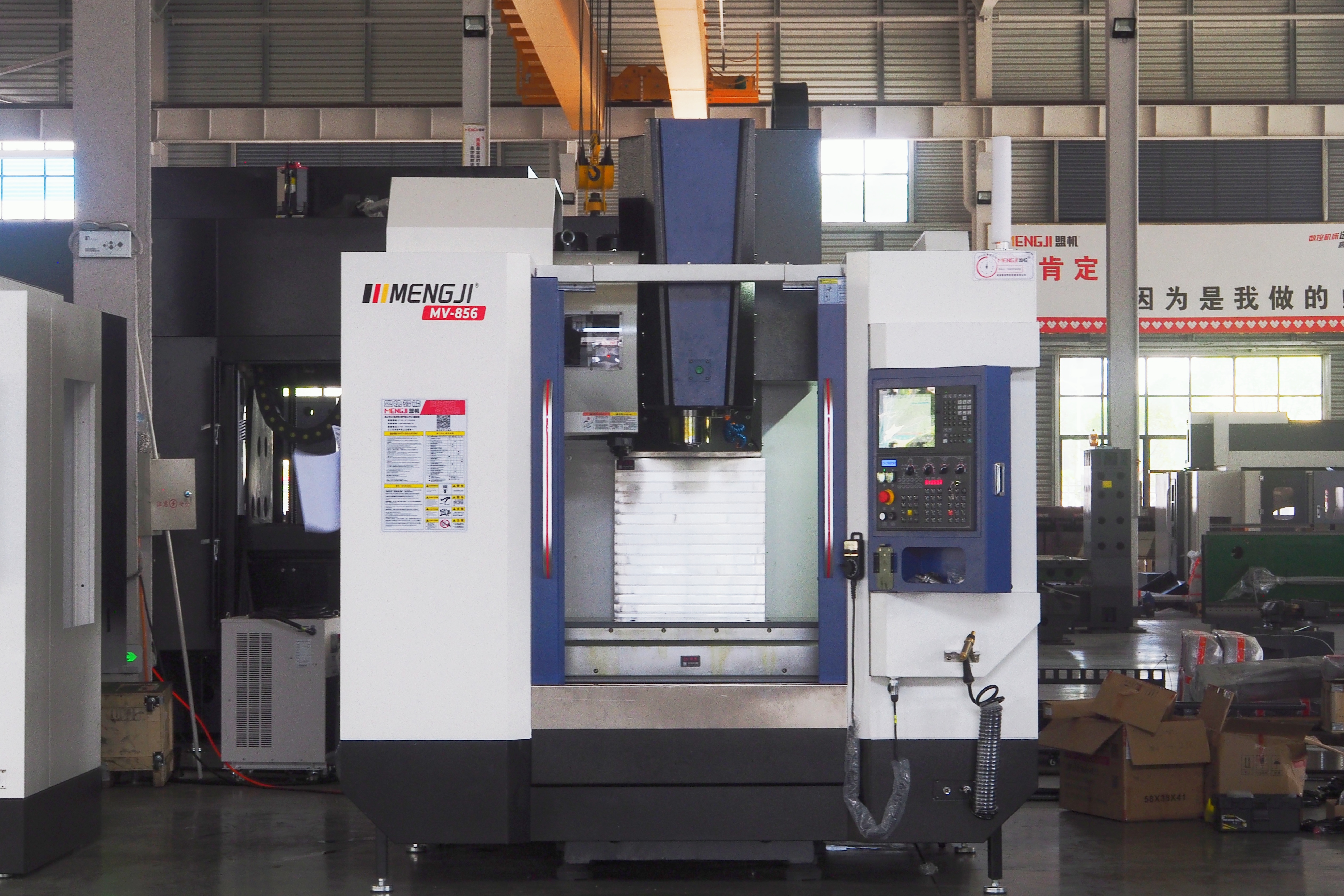
Achieving Tight-Tolerance Precision with Vertical Milling Centers
Why Rigidity, Thermal Stability, and Linear Scale Feedback Make VMCs Ideal for ±0.005 mm Hardware Tolerances
Vertical Milling Centers (VMCs) reach incredible levels of precision thanks to three main engineering concepts working together. First off, their rigid cast iron frames combined with reinforced guideways help stop tool deflection caused by vibrations when making aggressive cuts. Second, the machines use thermally balanced designs along with built-in coolant systems to combat heat-related drift problems, which matters a lot when working with materials like aluminum alloys that expand at about 23 micrometers per meter per degree Celsius. Third, linear scale feedback gives positioning accuracy down to just 0.1 micrometer, beating traditional ball screw systems hands down. All these elements work hand in hand to maintain tight tolerances of plus or minus 0.005 mm throughout entire production batches, even when dealing with tough materials such as hardened steel or titanium. And the best part? There's no need for extra measurement checks between operations, saving both time and money on quality control.
Real-World Validation: Aerospace Fasteners and Medical Brackets Machined to ISO 2768-mK on Entry-Level VMCs
Entry level vertical machining centers today can actually hit the ISO 2768-mK standard which is considered medium tolerance for things like airplane parts and medical hardware. A major manufacturer recently ran 17,000 titanium wing fasteners through their basic model VMC and got perfect results on bore concentricity, staying within 0.004 mm specs every time. For another project, they machined stainless steel surgical brackets needing positional accuracy of plus or minus 0.006 mm in one setup, and these components still met all the biocompatibility requirements. What makes this possible? The machines come equipped with built-in thermal compensation systems and direct drive spindles that keep errors minimal. While some might argue there's still room for improvement, these results clearly show that high precision manufacturing doesn't always require expensive top shelf equipment anymore.
Handling Geometric Complexity—from Simple Brackets to Multi-Axis Hardware Features
3-Axis vs. 5-Axis VMC Strategies: When Simultaneous Machining Adds Value (e.g., Titanium Enclosures with Undercuts)
When dealing with complex shapes, vertical milling centers rely on strategic axis configurations to get the job done right. For prismatic components like flat brackets or those flanged housing pieces, 3-axis machines tend to be the most cost effective solution. These platforms handle planar milling tasks, pockets, and standard drilling operations quite well. But when we look at more complicated parts such as titanium enclosures featuring undercuts, angled ports, or those challenging organic forms, that's where 5-axis VMCs really shine. The dynamic rotation of the workpiece during cutting allows these machines to complete intricate internal geometries all in one single setup. This eliminates those frustrating cumulative errors that happen with manual repositioning. Every time someone has to refixture a part, it can introduce tolerance drift of about 0.1 mm or worse, which adds up fast over multiple operations.
| Feature | 3-Axis VMC | 5-Axis VMC Advantage |
|---|---|---|
| Setup Changes | Multiple (2–6 for complex parts) | Single operation |
| Tool Accessibility | Limited by fixed angles | Full angular access for undercuts |
| Accuracy Risk | Tolerance stacking during flips | Consistent single-reference point |
For titanium medical housings, 5-axis machining reduces cycle time by 30% while sustaining ±0.025 mm positional accuracy across contoured surfaces—validating its role in high-value, low-volume hardware manufacturing.
Single-Setup Efficiency: Profiling, Drilling, Threading, and Deburring in One VMC Cycle
When integrated automation gets added to vertical milling centers, these machines become full blown part finishing cells. Modern systems come equipped with big tool changers that hold over 60 tools, plus they have programmable spindle positions and built in probing capabilities. What does this mean? A single run on a vertical machining center can handle profiling work, drill holes, tap threads, create chamfers, and even do some light deburring tasks all on its own without needing anyone to step in manually. Shops report cutting down on handling time by around 70% compared to older methods that required multiple machines. For manufacturers dealing with lots of different parts, this setup lets them go straight from a basic aluminum blank right through to a finished bracket complete with proper M6 threads, clean edges, and those critical hole to edge distances under 0.05 mm tolerance. Plus there's less scrap waste when things get misaligned and better consistency between all the different features on each component.
Material-Agnostic Performance Across Common Hardware Alloys
Optimized Cutting Parameters and Tooling Guidelines for Brass, 6061-Aluminum, 304 Stainless Steel, and Ti-6Al-4V on Standard VMC Platforms
Vertical machining centers achieve consistent accuracy when working with different types of metal because they match cutting techniques to how each material behaves rather than relying solely on what the machine can do. For softer materials such as brass or 6061 aluminum, operators typically set spindle speeds between around 12 thousand to 18 thousand RPM while keeping feed rates at a moderate level. This approach helps reduce built up edges and keeps dimensional accuracy within about plus or minus 0.01 millimeters. Things change quite a bit when dealing with harder stuff like 304 stainless steel though. Here, machinists need to slow down those spindle speeds to somewhere between 6k and 8k RPM but increase the amount of material removed per cut. The reason? To fight against the tendency of this steel to get even harder during machining. Using carbide end mills coated with TiAlN makes a real difference too, extending tool life roughly 40 percent compared to regular uncoated tools according to industry experience.
Titanium (Ti-6Al-4V) demands specific process discipline:
- Peck drilling prevents chip welding in deep holes
- High-pressure coolant (>1,000 psi) targeted at the cutting interface improves heat extraction and chip evacuation
- Radial engagement is limited to ≦35% of tool diameter to manage cutting forces and heat generation
These protocols allow standard VMC platforms to produce aerospace brackets and medical implants from Ti-6Al-4V with surface finishes under 0.8 μm Ra—and maintain dimensional stability within 5 microns across extended cycles, even when switching between aluminum and titanium workpieces.
Operational Advantages Driving VMC Adoption in High-Mix, Low-to-Medium Volume Hardware Shops
For hardware makers dealing with all sorts of small batch jobs, vertical milling centers really stand out when it comes to getting things done quickly. These machines take up about 30 percent less room compared to their horizontal counterparts, which means shops can fit more equipment in the same workshop space without feeling cramped. The automated tool changers and those pallet systems cut down on switching time somewhere around 40 to maybe even 60 percent. That makes it possible to switch from working on brass fittings one moment to aluminum brackets or stainless steel fasteners right after lunch break. Most job shops actually list reduced setup times as their number one concern for boosting productivity according to recent machining efficiency studies.
Integrated probing and IoT-enabled monitoring further minimize manual intervention—cutting labor costs by 22% while preserving ISO 2768-mK compliance. With ROI periods under 18 months for mid-volume runs (≦500 units), VMCs deliver measurable value through:
- Single-setup machining: Combining profiling, drilling, and threading in one uninterrupted cycle
- Scalable automation: Phased integration of robotic loading, vision inspection, and adaptive control
- Energy efficiency: 15–20% lower power consumption versus legacy systems
These advantages position vertical milling centers not as standalone tools—but as foundational assets for hardware shops balancing precision, versatility, and cost discipline.
Frequently Asked Questions
What are the main advantages of using Vertical Milling Centers (VMCs)?
VMCs offer rigidity, thermal stability, and precise linear scale feedback, which enable them to achieve tight tolerances of ±0.005 mm. They also provide efficient single-setup capabilities and material-agnostic performance for various hardware alloys.
How do VMCs handle different materials while maintaining precision?
VMCs adapt cutting parameters according to the specific material characteristics. For softer materials like aluminum, high spindle speeds are effective, while harder materials like stainless steel require adjusted speeds and specific tool types to maintain precision.
What is the difference between 3-axis and 5-axis VMCs?
3-axis VMCs are typically used for simpler, prismatic parts, while 5-axis VMCs handle complex components with dynamic rotations, allowing for intricate internal geometries to be machined in one setup.
Table of Contents
- Achieving Tight-Tolerance Precision with Vertical Milling Centers
- Handling Geometric Complexity—from Simple Brackets to Multi-Axis Hardware Features
- Material-Agnostic Performance Across Common Hardware Alloys
- Operational Advantages Driving VMC Adoption in High-Mix, Low-to-Medium Volume Hardware Shops
- Frequently Asked Questions