Installation Groundwork That Determines Everything Else
Longevity is not something you can bolt on later. It starts the moment the machine is placed on the foundation. A heavy cast iron bed needs a solid, level anchor point, and a rushed installation that skips a proper laser alignment of the linear guide ways will bake in geometric errors that only get worse as the machine racks through thousands of cycles. A plant engineering team in a gearbox housing shop once shared what happened when they moved a vertical machining center onto a pad that was slightly thinner than the foundation drawing specified. Within six months, the column squareness drifted enough to push bearing bore coaxiality out of spec, and they spent more on rework in that half year than the original installation would have cost if done strictly to the machine builder's foundation diagram. The ISO 230 series, particularly the part that covers geometric accuracy under no load and under finishing conditions, gives clear benchmarks for level, straightness and squareness that any installation crew should hit. Experienced service engineers also emphasize that ambient temperature swings inside a shop can twist a long bed by several hundredths of a millimeter, so placing the machine away from bay doors and direct sunlight, and letting the casting thermally stabilize for at least twenty four hours before running a ballbar test, is simply good practice that pays back over decades.
Lubrication and Coolant Hygiene as Daily Discipline
If you look after the lubrication system, the machine will look after you. That sounds like a workshop motto, but field data backs it up. Most unexpected spindle bearing failures and ballscrew pitting issues trace back to contaminated grease, low oil level or the wrong grease thickener that separates under centrifugal force at high RPM. A die and mold shop running high speed finishing operations discovered that switching from a general purpose lithium grease to a synthetic polyurea grease specified for high speed spindles extended bearing life from roughly 8000 hours to well over 14000 hours. That one change saved two spindle rebuilds over three years. Coolant concentration is equally critical. A refractometer check at the start of every shift takes thirty seconds, yet a coolant mixture that drops below the recommended concentration range invites bacterial growth that corrodes way covers and precision ground surfaces. Some manufacturers now build their machines with an automatic lubrication monitoring system that triggers an alarm if way lube pressure drops, and this small sensor alone has prevented scores of catastrophic slide seizures. The American Society of Mechanical Engineers publishes guidelines on machine tool lubrication best practices, and following those closely keeps the relationship between moving surfaces more like a glide than a grind.
Predictive Maintenance Over Reactive Firefighting
Most shops wait for a noise, a bad surface finish or an alarm before they act. By then the damage is already underway. A condition based maintenance approach flips that script. Laser interferometer checks every twelve months can catch a pitch error creeping up on a ballscrew before it translates into a rejected part. Vibration analysis on spindle bearings, using handheld accelerometers that cost less than a single emergency service callout, can spot early stage raceway spalling when it is still a polishing exercise rather than a replacement job. One production manager responsible for a cell of horizontal machining centers mentioned that after introducing quarterly vibration trending and annual backlash parameter updates, unscheduled downtime dropped from seven days a year to less than one day. The maintenance team stopped being firefighters and started being guardians of the process. Standards like ISO 13374 for condition monitoring provide a structured framework, but even a simple Excel log of ballbar results and spindle drawbar force readings builds an invaluable trend line that tells you exactly when to schedule an intervention during a planned shutdown, not during a hot production run.
Operator Skill and the Intelligence Behind the Controls
Even the most rigid machine tool becomes fragile in the wrong hands. Programming a rapid traverse that cuts a corner too tight or overriding spindle load limits because a part is running late can permanently dent a spindle taper or stretch a ballscrew nut. The difference between an operator who understands the inertia of a heavy table and one who simply hits the green button often shows up as a five year gap in machine accuracy life. Forward thinking shops invest in detailed training that goes beyond basic control navigation. They teach their people to read servo load meters, to feel unusual vibration through the floor and to know what a normal tool change sound should be. A shop supervisor once recalled how a young machinist noticed a slight hiccup in the tool clamp unclamp cycle and immediately paused the job. The issue turned out to be a weakening Belleville spring stack in the spindle drawbar. Catching it before it failed saved the spindle taper, the toolholder and the part, a repair that could have cost thousands and sidelined the machine for two weeks. Human attentiveness, paired with control features like adaptive feed rate override based on spindle load, creates a protective layer that no amount of iron alone can provide.
Genuine Spare Parts and Factory Backing That Add Years
When a spindle cartridge eventually needs service or a way cover wiper wears out, the temptation to source a cheaper alternative that looks identical is strong. But dimensional fits, heat treatment specs and seal compounds are often subtly different. An automotive parts supplier learned this the hard way when they fitted aftermarket linear rail bearings that were supposedly equivalent to the original equipment. The replacement bearings had a slightly lower preload class, and within four months the positioning repeatability on that axis degraded enough to generate borderline capability indices on a steering component. Genuine parts from the machine builder carry the original engineering intent, and the factory can advise on correct installation procedures so that a bearing replacement does not introduce a fresh alignment error. Beyond spare parts, a responsive local service and applications team that understands the machine's control architecture can diagnose problems remotely, often solving an alarm issue over a video call rather than putting a machine out of production for a day. That kind of support network turns a machine purchase into a running partnership.
Building Endurance Into the Machine from the Start
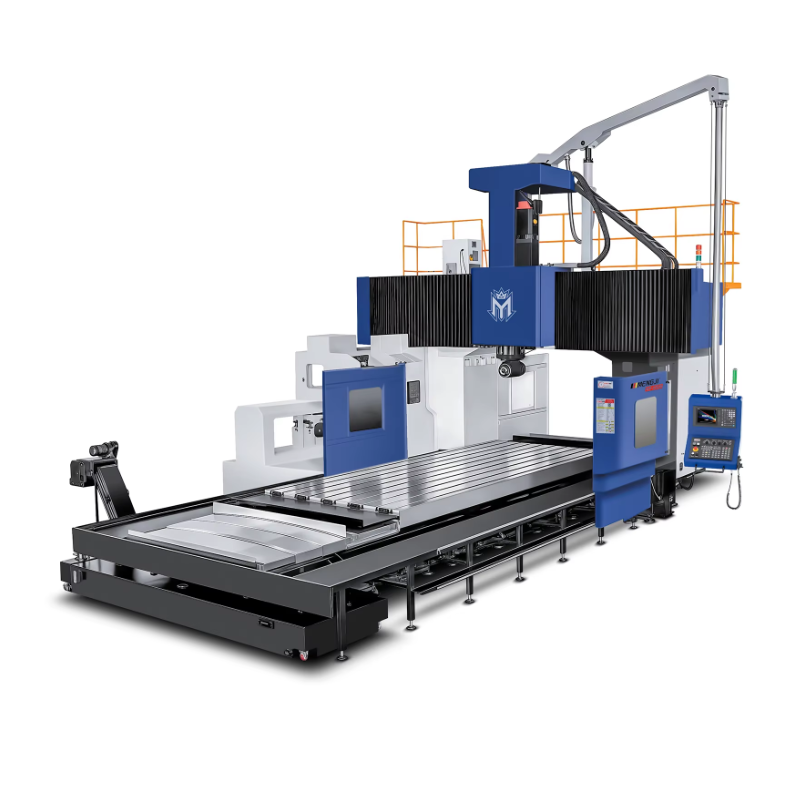
All the maintenance discipline in the world can only do so much if the machine itself was not engineered for the long haul. That is where the manufacturing philosophy of a builder like Mengji makes a concrete difference. Mengji designs its vertical and horizontal machining centers with heavily ribbed castings that are stress relieved and then precision machined on portal mills, a sequence that locks in long term geometric stability. Their supply chain is organized to keep critical components like spindle cartridges, ballscrew assemblies and servo drives from established global suppliers in consistent stock, so a replacement part does not force months of downtime. Mengji also provides on site commissioning support that includes a full laser calibration and a ballbar circularity test before the machine ever runs a production part. That kind of factory backed start in life, combined with structured maintenance, is what turns a made in China CNC machine tool into a multi decade production asset. When the goal is longevity, choosing a builder who treats every casting, every way wiper and every line of ladder logic as a long term commitment is as important as any maintenance checklist.
Table of Contents
- Installation Groundwork That Determines Everything Else
- Lubrication and Coolant Hygiene as Daily Discipline
- Predictive Maintenance Over Reactive Firefighting
- Operator Skill and the Intelligence Behind the Controls
- Genuine Spare Parts and Factory Backing That Add Years
- Building Endurance Into the Machine from the Start